


Fintech giant Ramp is filled with high school dropouts, competitive math champions, and Minecraft whizzes. Their common attribute? An outlier skill or ability in one particular field. In an increasingly competitive hiring market, take a page from Ramp’s playbook for hiring spiky, mispriced talent to maximise return.
Eric Glyman hires people who are really, really good at video games. Specifically, he’s hired an entire cohort of people who have spent hours playing and building mods for the open-world sandbox game Minecraft.
“It’s an early signal that there's something unusual going on in terms of someone's ability to focus and persevere,” he says. When hiring for a startup, “you're trying to look for some evidence of a spike or some level of exceptional drive” - this is the bar for hiring at Ramp, and they have proof it works.
According to Glyman, the company’s Co-founder and Co-CEO, Ramp is home to an entire community of engineers who were recruited because, when they were 15 years old, they were spending 80 to 100 hours a week playing Minecraft. “A few of them were known for building these private Minecraft servers that were so entertaining, other kids would love to play it. One of them paid his way through college, hundreds of thousands of dollars, by making something that was entertaining.”
This is Glyman’s way of saying that taking the traditional approach to hiring often means a company is going to miss out on exceptional talent, simply because someone hasn’t followed a typical career progression or isn’t well-rounded.
A well-rounded hire shouldn't be the goal for a startup. The spiky hire, as Glyman and his colleagues term it, usually brings a much more important set of characteristics: passion, obsession, and a track-record of having built things on their own. “I'm less interested in what is in the resume. I'm far more interested in proof of work.” Plus, spiky talent is often mispriced because it is undervalued by the market.
Speaking about a particular engineer on his team, who was hired for his Minecraft capabilities, Glyman explains “he has this incredible focus and drive… he was incredibly obsessive, super detailed, and he was able to bend the API to do things that we didn't know it could do because he was so discerning."
The proof is in the growth. Today, Ramp is valued at $44 billion and used by over 70,000 businesses. Over 3% of all of the corporate card transactions in the United States are powered by Ramp.
Glyman has unpacked the Ramp hiring philosophy across several interviews over the past few years, including a presentation at the Art of Hiring event, and a podcast interview with David Senra. His two key hiring moves: find people with spikes, and give them the tools to be dangerous. Everything follows from that.
Finding the spike: Skip the generalist, look for black sheep
Hiring passionate gamers is just one part of Glyman’s overall hiring strategy, which involves seeking out super individual contributors (ICs) who create leverage by being especially talented in one specific area.
This includes anyone who ticks the box of atypical talent: ex-founders (Glyman estimates there are currently over 70 in the company), mathematics olympiad winners, poker and board game enthusiasts, and people who had weird, obsessive teenage hobbies.
Ramp doesn’t look for generalists. They prefer black sheep - people who are not obviously strong hires. Glyman locates the origin of this philosophy within his own life: “This one is a little bit personal for me. My older brother has Asperger's. He has learning disabilities. Things got really hard for him because he did not fit in the traditional way that people learn.”
But Glyman, who looked up to his older brother as a hero, couldn't understand why someone with his brother’s unique strengths was struggling so much. “He had the most unbelievable memory and could tell you within an instant what was going on in the year 421 BC in this part of the world”
“He had extreme spikes, but, frankly, really struggled to go through high school. And I always just remembered thinking that in certain contexts he could really thrive and he could do things really well. Happily, he's found that. And there are many people with stories, like him.” Those are the kinds of people who Ramp actively searches for.
Here are the five tactics Ramp uses for finding and selecting spiky talent:
#1 Write unreasonably short job descriptions
Most job descriptions include a long list of very specific requirements - from years of experience to proficiencies in certain software. This is the first hiring mistake, according to Glyman.
“With every new requirement, you're narrowing and dividing. What could have been tens, hundreds, thousands of applicants, you've narrowed down to maybe like five, which probably raises their price.”
Glyman’s solution is to zero in on the core competency - the big spike - that matches the problem you need the hire to solve. “I think as a startup, early on, there should be one thing that you're looking for. If you are looking just for one particular thing, you're going to be better able to assess spikes and you will more quickly be able to discern someone truly world class.”
“Practically, the lesson is that you should write unreasonably short job descriptions and know exactly what you're looking for,” says Glyman. “That makes it easy to compare candidates at one vector that really matters for your business.”
#2 Look for people with world-class taste
The 2011 documentary Jiro Dreams of Sushi, directed by David Gelb, follows Jiro Ono - an 85-year-old sushi master who still serves most nights at Sukiyabashi Jiro, the first sushi restaurant in the world to earn three Michelin stars, tucked into the basement of a Tokyo subway station.
“He’s a pretty unusual guy,” says Glyman. “There's an amazing scene where the narrator asks him: Jiro, what is your secret? How do you make such great sushi? And his answer is deceivingly simple.”
Jiro tells the interviewer that, in order to make delicious food, a person needs to eat delicious food. The quality of ingredients is important, but one must develop a palate capable of discerning good and bad. “Without good taste, you can't make good food. And if your sense of taste is lower than that of the customer, how is it that you will impress them?”
For Glyman, the lesson is that the best sushi chefs start their career tasting sushi, not making it - that’s how they hone their craft and develop world-class taste. Spiky hires develop taste the same way: by being obsessed with one narrow thing until they have real opinions about it.
“In early hires, you want to be looking for people who have very specific, sometimes stubborn, but certain views about the world. A lot of people are good generalists. It's much rarer to find people with particular opinions, people who've created a certain craft.”
That taste is what lets a young company stand out. "As a small startup, or even a company scaling, you need to be fairly opinionated in the products that you make, what you put out in the world. You need to be distinct in order to stand out in a very busy world."
The way to spot it is to look past the logos on a résumé and ask what the person actually built there. "Find people who have done the work," Glyman says - "sold the deals, written the copy, designed an interface. Not just once, but day in, day out." Ramp very rarely hires managers to drop straight into the company; it prefers people who've done the work themselves. Those people arrive with taste already built - and, as a bonus, they attract others who hold the same standard.
#3 Hire for slope over intercept
Traditional wisdom says that someone with many years of experience can create more value for a business than the 18 year old freshman intern. Glyman advocates for the counterintuitive approach: go for slope over intercept.
To understand his metaphor, picture someone's ability plotted against time. The intercept is their starting point on day one: their current skill, credentials, years of experience (technically, it’s the part where the graph intercepts the y-axis - hence the name). The slope is their rate of growth - how fast they learn and level up.
Hiring for slope over intercept means betting on their trajectory rather than their starting point. In other words, taking the junior, spiky hire who's climbing steeply over the credentialed generalist who's already plateaued.
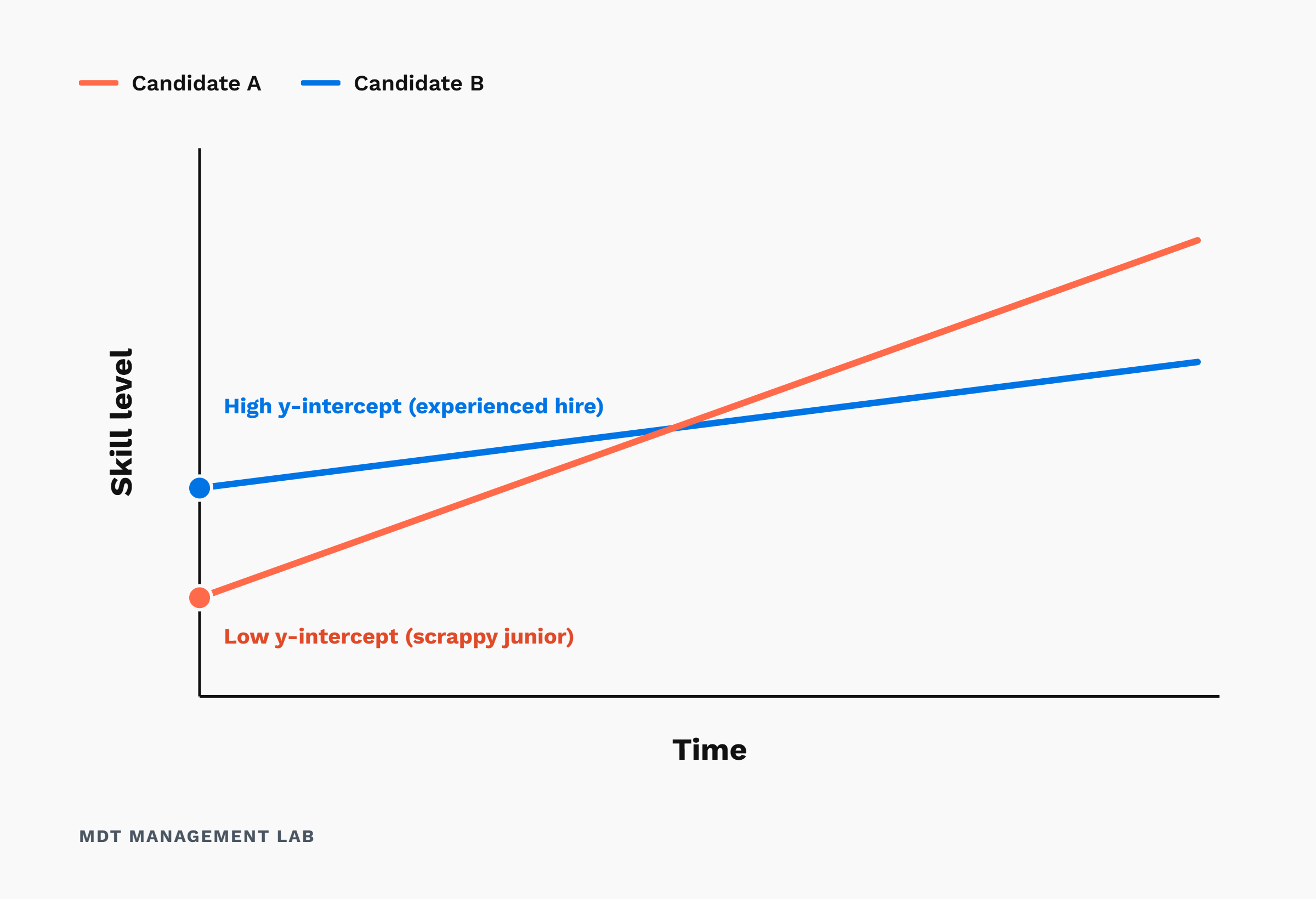
"We try to find people with super steep slopes. Often people have real gaps and that's okay. We make bets on people. The goal is not an absence of problems, but 10x potential,” says Glyman.
One practical way to implement this advice is to find people who are still early in their careers, or even still studying - not just because of their potential, but because it means locking them in while they’re still affordable.
Glyman recommends getting to know them early. One way of doing this is offering internships outside of usual timeframes, taking them to dinners, and making them feel part of the team - before they get there; “We'll offer winter internships, fall, spring. Meeting people early and investing in genuine relationships is a way that you can compete in mispriced talent pools.”
The market for people is the world’s most competitive market, according to Glyman. The slope over intercept approach allows a business to find people who would create a lot more value than what it costs to pay them at the time.
#4 Challenge candidates to a debate
A generic interview process produces generic results. To be sure that a candidate is suitable for a specific role, Glyman recommends intentionally designing different interview formats per role.
“For example, if you're interviewing for something at Ramp, one of those interviews may be designed to debate you on something. We’ll find something you say and just disagree with you on it.”
The goal of this approach is to pick up one particular signal. Ramp is looking for determined, stubborn, black sheepish, very individual people. If Ramp’s playbook has been followed, the interviewee will be highly opinionated with great taste - which means they’ll almost certainly get into a debate when challenged. This is exactly the signal to look for.
#5 Strong yes or bust
At Ramp, there are four grades a potential candidate can receive post-interview: strong no, no, yes, or strong yes. “And often with people who are kind of good, they’ll get six yeses. But at Ramp, that’s a no.”
“You want there to be someone who is going to pound the table and say I'm going to go and make this person successful, particularly if they are the hiring manager,” says Glyman. A strong, emphatic yes can even override someone else’s no, because that person is saying they will put themselves on the line to make the hire work.
“In looking for convictions in certain spikes, you want to be looking for very strong yes’s. Otherwise, keep waiting, passing. You want people with deep taste, spikes, capabilities.”

The conditions for success: Build the place where spikes can succeed
Finding the spike is only half the job. The other half is what happens after the offer's signed - and it's where most companies waste the talent they worked so hard to find.
Once the hires have been made, the company has to be designed around it; “you have to think hard about how to put them in roles where they can express that and give them tools and technology that augment and enhance that ability. Give them resources, build teams around them, and hopefully convince them of why the Ramp opportunities are exciting to stay for many years.”
Ensuring the hire stays is particularly important if a company has hired for slope-over-intercept, because the bet only pays off if the steep-climbing person is still climbing at the company in five years. Building the conditions for a spike to compound is part of what keeps them.
Nowhere is this second principle clearer than in what AI is doing to the value of a spike. Asked whether the rise of AI agents changes how Ramp thinks about hiring, Glyman's answer is that it only sharpens the logic: the returns on talent have never been higher.
“The most effective person in the world is no longer 10 times as effective or 100 times as effective - they could be 1,000 times as effective in a particular area.”
Glyman’s argument is that AI is making it easier for spiky talent to get involved outside of the boundaries of their expertise. “If you find really determined people with a high level of determination and an aptitude, they can do far more than they ever used to be able to do, so it's not restricted just to specific spikes.”
This is where everything comes together, and why Ramp’s playbook can easily be distilled into the two simple principles. First, find deeply talented people who spike in specific areas. Then build the company - the roles, the teams, the tools - where they can achieve outsized success within, and beyond, their spike.
“The team you build is the company you build. We actively try to be a place where we attract people who want to make a dent in the universe, want to create something worth creating,” concludes Glyman.

